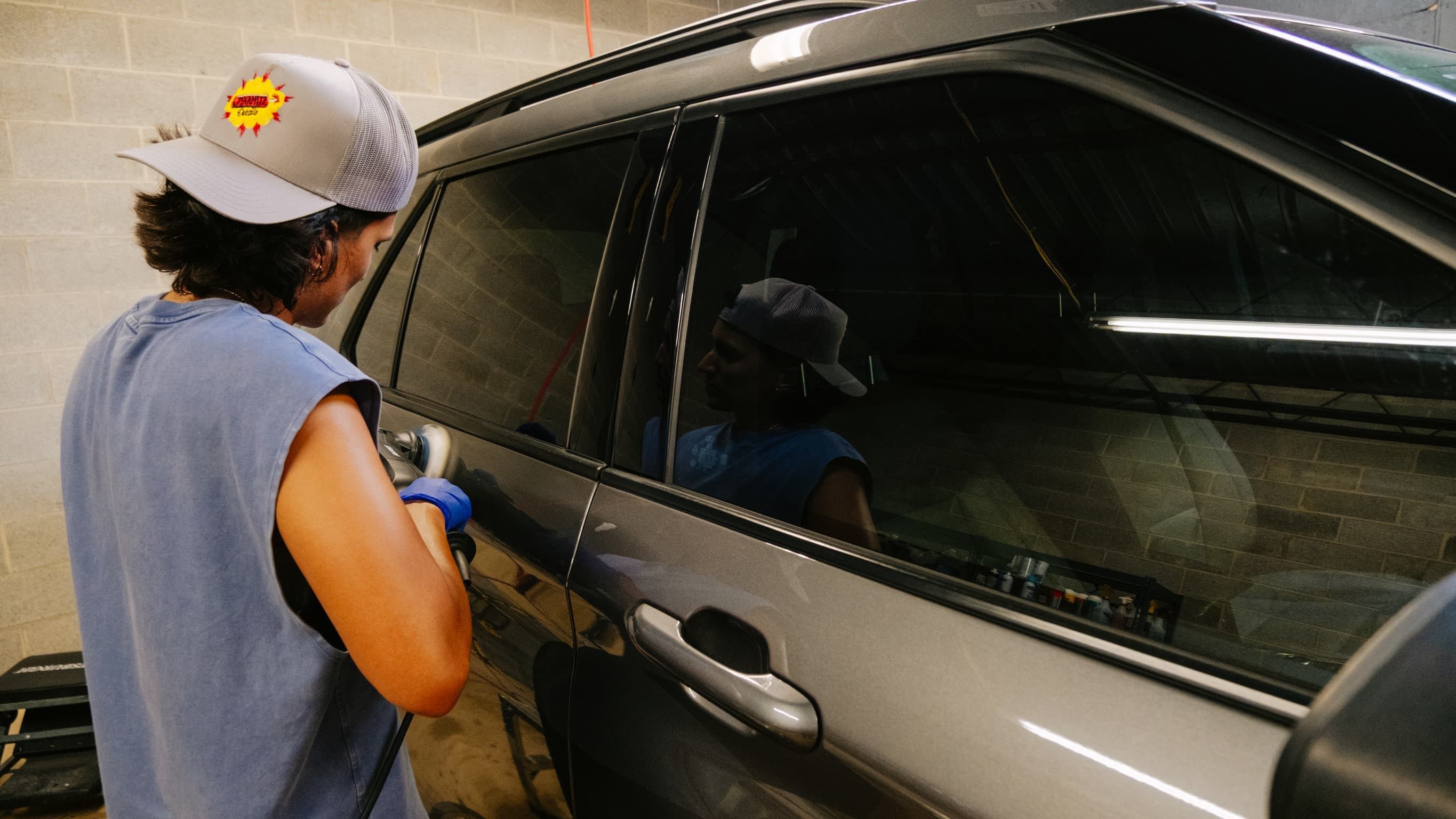
Paint correction is machine polishing that removes swirl marks, marring, light scratches and oxidation from your clear coat, instead of hiding them under wax. At Dynamite Details in Middletown, DE, paint correction cost starts at $200 per panel, with an 8-hour minimum. Every job starts with a free 30-minute estimate, because the price depends on your paint depth and how many steps it needs. See our paint correction services for the 1-, 2- and 3-step levels. We do all correction at our studio by drop-off. We measure the paint with a gauge before we polish, since clear coat that is polished away can't be put back. Your car needs correction when the paint looks dull or swirled in direct sun, or before a protective coating goes on. A coating seals in whatever is under it, so the paint should be corrected first. Correction won't fix damage that has gone through the clear coat.
What does paint correction actually fix?
Paint correction works on the clear coat, the clear top layer of your paint. Most everyday damage lives there. That includes:
- Swirl marks, the fine circular scratches you see in direct sun
- Marring and haze from washing and drying
- Light scratches that haven't broken through the clear coat
- Oxidation that makes the color look flat or chalky
Correction has limits, and we tell you up front. Damage in the base coat, the color layer, can be improved but not fully removed. Once damage reaches the primer or bare metal, polishing can't help, and the panel needs paint.
What about deeper scratches?
For scratches that go past the clear coat, we can do a scratch repair. We measure the depth, wet sand if needed, and apply base coat in thin layers that each dry fully. Then we apply clear coat, blend it with correction and protect it with a Revivify coating or sealant.
How does paint correction work?
Your paint is a stack of thin layers over the metal: primer, base coat and clear coat. According to paint-gauge maker DeFelsko, clear coat is usually just 1.5–2.0 mils (35–50 microns) thick. Most factory paint jobs total 4–7 mils. The same source notes that most auto makers recommend removing no more than 0.3 mils (8 microns) of clear coat.
That is not much room. So at our Middletown studio, every correction follows three steps:
- We assess first. A paint gauge measures the depth we have to work with, and we inspect the surface up close.
- We correct precisely. We pick the machine, pad and product combination for your paint. Paint is like a fingerprint, unique to the car it is on.
- We protect the result. A Revivify self-healing protective coating seals the corrected surface so it stays that way.
What are the 1-step, 2-step and 3-step correction levels?
We match the correction to the damage. Here is how each level works at Dynamite Details, with our real pricing.
| Level | What it fixes | Our rule | Price |
|---|---|---|---|
| Enhancement | Adds shine to paint in good shape; polish with hydrophobic beading | Lasts up to 9 months, or up to 1 year with a Revivify Sealant | Estimate required |
| 1-step correction | Minor swirls, marring and light scratches | Not paired with a Revivify coating on its own | From $200 per panel, 8-hour minimum |
| 2-step correction | Moderate swirls, marring and scratches | Always installed with a Revivify coating | From $200 per panel, plus coating estimate |
| 3-step correction | Heavy scratches, swirls and marring | Minimum 8 hours, estimate required | From $200 per panel |
Why won't we do a 2-step correction without a coating?
The first step cuts into the clear coat to remove defects. The second step polishes for shine. That leaves you with slightly thinner clear coat. We will not deliver a thinner clear coat without protecting it, so every 2-step gets a Revivify protective coating.
Why no 1-step correction with a Revivify coating?
A Revivify coating gives deep, wet-looking gloss. To get the most from it, we correct the swirls and then polish. One without the other won't look as good, so our minimum before a Revivify coating is a 2-step.
How much does paint correction cost at Dynamite Details?
Paint correction at Dynamite Details starts at $200 per panel, with an 8-hour minimum. The final price is set at your free 30-minute estimate. Four things move it:
- How many panels need work
- How many correction steps your paint needs
- How much clear coat your gauge readings show
- Whether a Revivify coating or sealant goes on after
Revivify coatings are priced separately after the estimate. Revivify comes in four levels: G-Pro, Lite, Ultra and X. Our Revivify G-Pro is about a 12-hour application. Our highest level, Revivify X (CarbonX), is about a 48-hour application. All Revivify packages include wheels (calipers and barrels), and all are done at our studio.
Correction is not the same as a detail. If your paint just needs cleaning and protection, a Full Signature Detail is $400 at our studio or $450 mobile, with 6–9 months of protection. An Exterior Signature Detail is $300 studio or $350 mobile.
How long does paint correction take?
Plan on at least 8 hours. Multi-step corrections on heavily marred paint take longer. All correction happens at our studio at 563 Old Summit Bridge Rd Unit A in Middletown, by drop-off. If you add a Revivify coating, allow for its application time as well.
When does your car actually need paint correction?
- Before a coating. A coating locks in whatever is under it. Swirls under a coating stay visible for its whole life.
- When the paint looks dull or swirled in direct sun. Flat color and spiderweb scratches are clear coat damage.
- After years of automatic car washes. Brushes drag grit across the finish every visit.
- Before you sell or trade in. Clean, glossy paint makes a better first impression.
- On a new car with thin paint. Many owners protect early instead. Our Tesla paint protection guide covers that choice.
Is enhancement or correction right for your paint?
Enhancement brings shine to good paint. Correction fixes damaged paint. An enhancement is like a 1-step correction, but it uses a polish with light abrasives that leaves the surface beading water. It lasts up to 9 months, or up to a year with a Revivify Sealant. If your paint has visible swirls or scratches, you need correction, not enhancement. We will tell you which one at the estimate.
How do you keep paint looking corrected?
Correction without protection doesn't last. New wash marks start forming as soon as the car is back on the road. That is why we pair correction with protection.
- Seal it. A Revivify self-healing coating re-flows under heat to close light surface marring.
- Hand wash with clean mitts and dry with clean microfiber towels.
- Skip automatic brush washes.
- Book a maintenance detail to keep the protection working.
Why have Dynamite Details correct your paint?
Dynamite Details is a woman-owned studio in Middletown, DE, held to the same standard of qualifications and certifications its owner built her career on.
We are a certified Revivify installer, and we measure before we polish on every car. Call (302) 468-7753 or book your free paint correction estimate.