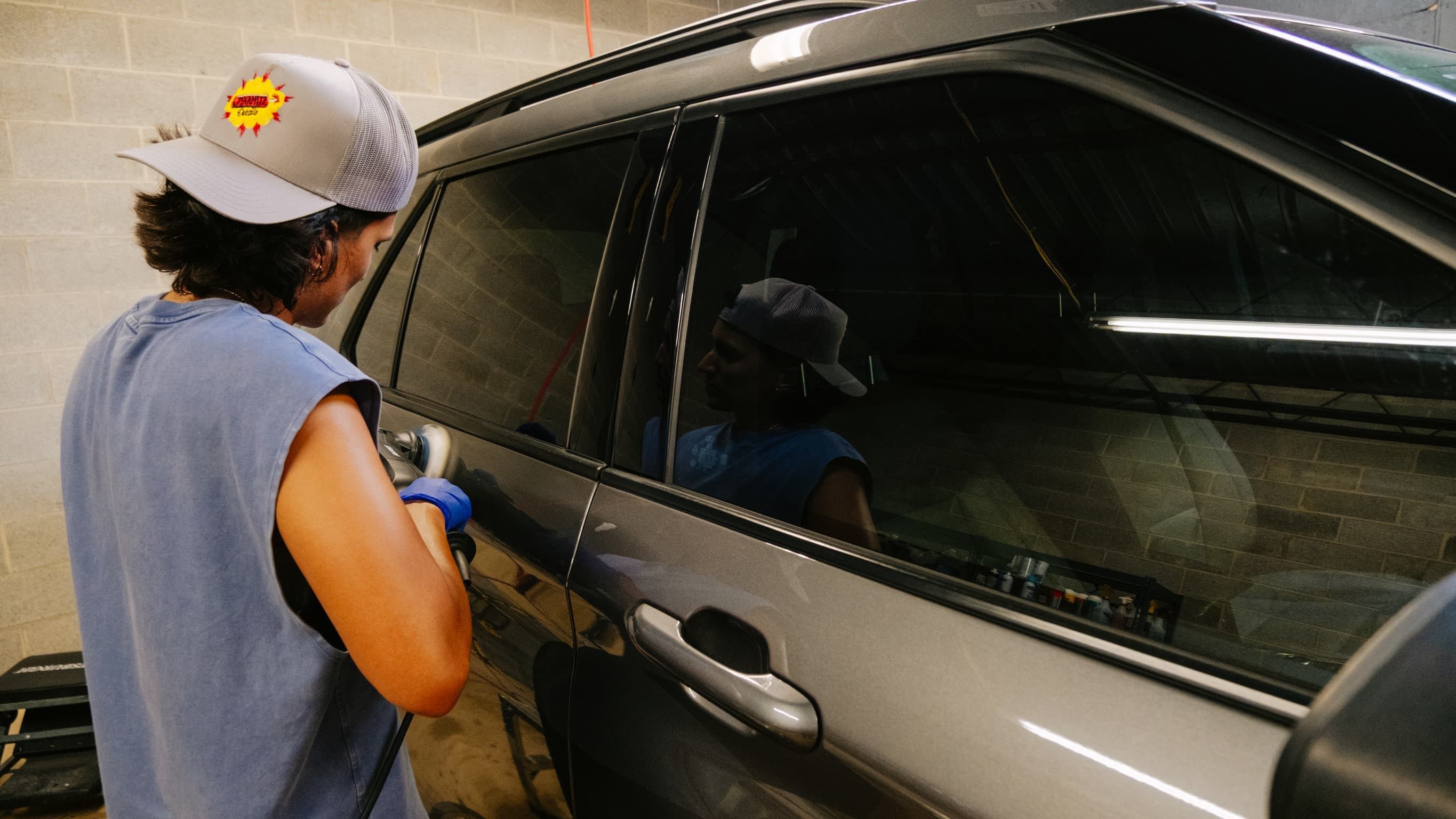

A marine ceramic coating protects a boat far longer than wax. In the marine ceramic coating vs wax choice, BoatUS says wax falls short unless you reapply it every six to eight weeks. A professional coating is meant to last up to several years. Dynamite Details offers both paths across the Delmarva Peninsula. Our mobile boat detailing and Revivify Marine Coating service comes to your boat. Our Wash & Wax and polish packages finish with a marine sealant. For long-term protection, we install Revivify Marine, a self-healing protective coating built for salt, fresh, and brackish water. Coating work needs an estimate, because any oxidation must come off first. To keep either finish clean, our wash plans cost $89 per foot annually for weekly service, $59 for bi-weekly, and $39 for monthly.
| Option | How long it lasts | What it protects | Upkeep | What Dynamite charges |
|---|---|---|---|---|
| Marine wax | Falls short unless redone every 6 to 8 weeks, per BoatUS | Shine and a thin UV barrier | Reapply 3 to 4 times a year or more, per Boating Magazine | Estimate required |
| Marine sealant (our Wash & Wax and polish packages) | Shorter than a coating; renew it with each package | Gloss, beading, and a barrier on clean gelcoat | Regular fresh water washes | Estimate required |
| Marine ceramic coating (SiO2) | Up to several years, depending on storage, per BoatUS | Hard, glossy layer against UV and dirt | Washes, plus spray aftercare every few months | We install Revivify Marine as our coating |
| Revivify Marine self-healing coating | Years of protection, not months | Bonds to the surface and self-heals micro-damage | Regular fresh water washes | Estimate required |
| Wash management plan | Ongoing | Clears salt spray and water spots before they set | We handle it | $89 weekly / $59 bi-weekly / $39 monthly, per foot annually |
Why does marine wax wear off so fast?
Wax is sacrificial. It wears away so your gelcoat does not. Sun, salt, and every wash take a little of it with them.
BoatUS explains that time and exposure erode the soft surface of gelcoat and leave it dull and chalky. Wax slows that down, but only while it is there. BoatUS calls wax the top weapon against oxidation, yet says it is inadequate unless you wax every six to eight weeks. Boating Magazine suggests reapplying three to four times a year.
On the Delmarva, the water makes this harder. Fresh water leaves mineral deposits that eat through wax and sealant. Brackish water in the Chesapeake and Delaware Bays speeds up corrosion. Atlantic salt gets into every gap and seam.
How does a marine ceramic coating work?
A coating fills the tiny pores in gelcoat and cures into a hard, glossy layer. BoatUS says a coating does what wax does, but for longer, and with more gloss. It repels dirt, beads water, and guards against UV.
It is not zero upkeep. BoatUS notes the boat still needs regular washing. Some products also call for a spray-and-wipe aftercare every few months. Think of a coating as a longer-lasting base, not a force field.
What makes Revivify Marine different from a standard ceramic coating?
Standard coatings fail on the water. That is the problem Revivify Marine was built to solve. It bonds at the molecular level and self-heals micro-damage before corrosion starts. It is made for salt, fresh, and brackish water.
Revivify is a urethane-based, self-healing protective coating. Rigid ceramic coatings use silica (SiO2) and cure hard. Revivify stays flexible, so it stands up to salt and strong sun where rigid coatings can crack. Heat helps it heal light marks from docking, lines, and washing.
Dynamite Details is a certified Revivify installer. You can compare all four levels (G-Pro, Lite, Ultra and X) on our Revivify self-healing coatings page. We also apply Revivify Aviation Coating to aircraft exteriors.
Can a coating go over oxidation?
No. A coating seals in whatever is under it. As one installer told BoatUS, all oxidation, scratches, swirls, and old wax must be removed first.
That is why our marine work is a ladder. We match the package to how your gelcoat looks today:
- Wash & Wax: for boats in new or like-new shape. Deep cleaning of compartments, non-skid, stainless, upholstery, and isinglass, finished with polymer sealant.
- Polish & Wax (Rejuvenation): for newer boats with minor flaws. Decontamination, water spot removal, a 1-step polish, and 1 coat of marine sealant.
- Renewal Plan (Rise & Shine): for medium to light oxidation. Heavy cut compound, medium cut compound, polish, and marine sealant.
- Complete Restoration: for medium to heavy oxidation. Adds glass polishing, stainless hand polish, rust removal, deck sealing, and 1000 and 2000 grit wet sanding if needed.
- Boat Oxidation Removal: priced on site by severity. A free test spot is available on request. It requires a Wash & Wax package first.
Is the Wash & Wax package actually wax?
Not in the old paste-wax sense. Our Wash & Wax package is finished with a polymer sealant, and our polish packages finish with marine sealant. That sealant adds gloss and a barrier on clean gelcoat. It is still a seasonal layer, though, not a multi-year coating. If you want protection that lasts for years, that is what Revivify Marine is for.
Does this apply to yachts, jet skis, and aircraft?
Yes. We provide exterior and interior service for boats and yachts, jet ski detailing and protection, and exterior service for aircraft. For aircraft, Revivify Aviation Coating offers the same self-healing, deep-gloss protection, with UV resistance and chemical defense built for aviation surfaces.
What does each option cost at Dynamite Details?
Our wash management plans are the one marine price we publish as a flat rate. They run $89 per foot annually for weekly service, $59 for bi-weekly, and $39 for monthly. Every plan includes a fresh water wash, salt spray rinse, and spot drying. Bi-weekly adds an oxidation check. Monthly adds an oxidation check and a corrosion assessment. Custom plans are available.
Detailing packages, oxidation removal, and Revivify Marine all need an estimate. Every hull is different, and oxidation can range from light haze to heavy chalk. We would rather see your boat than guess at a number.
Which should you choose?
- Choose marine wax if you enjoy doing it yourself and can reapply every six to eight weeks in season.
- Choose a Wash & Wax or polish package if your boat is newer and you want a clean, sealed finish this season.
- Choose a Renewal or Complete Restoration package if the gelcoat looks dull or chalky. Fix the oxidation before you think about a coating.
- Choose Revivify Marine if you plan to keep the boat for years and want protection built for salt, fresh, and brackish water.
- Choose a wash plan with any of the above if you would rather spend your time on the water than scrubbing the hull.
How do you keep a coated boat looking new?
Rinse it with fresh water after every trip. BoatUS advises washing down the boat and trailer as soon as possible after a day in salt water, within a few hours at least. Dry it after washing so mineral spots do not set.
A wash plan takes that job off your list. For more on how each Delmarva water type attacks a hull, read our guide to protecting a boat from salt, brackish, and fresh water.
Who does the work on your boat?
Dynamite Details is a woman-owned detailing studio at 563 Old Summit Bridge Rd Unit A in Middletown, DE. Marine work is 100% mobile, so we travel to your marina or wherever the boat sits. Call (302) 468-7753 or get a free marine estimate.